NanoVNA · Volume 2
The Hardware — What the Model Families Actually Differ By
The 2019 origin and why a sub-$100 instrument can do useful vector work at all; the fundamental-versus-harmonic architectural fork that actually separates one NanoVNA from another; the original NanoVNA/H/H4 lineage, the from-scratch NanoVNA-V2 (\"S-A-A-2\") architecture, LiteVNA-64, and NanoVNA-F V3, model by model; dynamic range quoted with the frequency it was measured at, not as a bare number; a verified comparison table and selection guide
2.1 About this volume
Every volume in this dive assumes you already have a NanoVNA on the bench, and most of them treat “the NanoVNA” as a single instrument — one error model, one calibration discipline, one measurement workflow. That fiction is convenient and, for the discipline this hub actually teaches, mostly harmless: Vol 1’s reflection-coefficient theory and Vol 3’s calibration math apply identically whether the silicon underneath the touchscreen cost $80 or $300. It stops being harmless the moment you go shopping, because “NanoVNA” is not one product, it is a trademark-free name that at least four genuinely different hardware lineages have converged on, and the difference between them is not cosmetic. Two instruments both marketed as “up to 3 GHz” can differ by 30+ dB of usable dynamic range at 1 GHz depending on whether that 3 GHz figure comes from a wideband synthesizer that tracks the stimulus 1:1, or from a 300 MHz synthesizer being driven at a sub-harmonic and relying on the mixer’s own harmonic content to reach the target frequency. This volume exists to make that difference legible before you spend money on it.
The scope here is narrow and deliberate. This is not a history volume — §2 covers the 2019 origin and the price collapse in a few paragraphs, only as far as it explains why a sub-$100 instrument can do useful vector work at all, and then gets out of the way. It is not the calibration volume (Vol 3), the measurement-technique volume (Vol 4), or the field-workflow and ranked-buy volume (Vol 5); those own their own territory and this volume cross-links into them rather than re-deriving anything they cover. What this volume owns is the hardware itself: the architectural fork that actually matters (§3), the specific model families built on each side of that fork (§§4–7), an honest accounting of what “dynamic range” means when the manufacturer does or does not attach a frequency to the number (§8), and a comparison table with the selection logic that follows directly from the architecture rather than from marketing copy (§9). Every model name, frequency figure, dynamic-range figure, and price quoted below was checked this session against a manufacturer or current vendor page, dated as of late July 2026; where a figure could not be independently confirmed, that gap is stated rather than papered over with a plausible-sounding number.
2.2 Why the NanoVNA family exists — the 2019 origin and the price collapse
The NanoVNA project traces to a single named author: edy555, who released the original design in 2019. The project’s own site is unambiguous on the point, describing the instrument as “originally designed by edy555” and noting it “has become the most popular VNA and antenna analyzer project in the community since its release in 2019.” The original board was modest by the standards this volume’s later sections will describe — a Si5351 synthesizer chip driving a simple sampling front end, covering roughly 50 kHz to 300 MHz in fundamental operation — but it was open, it was cheap to fabricate, and it worked well enough to do real S11/S21 measurement on an amateur bench for the first time at a price that had nothing to do with what a two-port vector network analyzer had cost up to that point.
Hugen (hugen79) took the open design and improved the hardware almost immediately: the same source describes two distinct contributions in two separate sentences, worth quoting separately rather than run together: hugen’s NanoVNA-H “improved NanoVNA with a 5V DC-DC boost converter, which enables stable operation driven solely by a 3.7V Li-ion battery,” and, separately, that “Hugen’s design extended the measurement frequency up to 900MHz by using harmonics of the internal frequency synthesizer.” That second half of the sentence is doing more work than it looks like, and §3 exists specifically to unpack it — the 900 MHz figure is not a new fundamental range, it is the original 300 MHz Si5351 core being pushed past its own limit by a technique with a real, quantifiable cost. Contributions from cho45 and continuing maintenance from DiSlord kept the firmware evolving from there, and the lineage that runs from edy555’s original board through hugen’s NanoVNA-H and NanoVNA-H4 is, architecturally, still the same Si5351-based design at its core — §4 covers that whole family together for exactly that reason.
What actually collapsed the price barrier was not any single component — Si5351 synthesizer chips, STM32 microcontrollers, and small color TFT touchscreens were all already commodity parts by 2019, each costing a few dollars in volume. What collapsed was the idea that a two-port vector network analyzer needed six figures of R&D amortized into every unit. A directional bridge built from surface-mount resistors and a length of PCB trace is not as good as a lab-grade coupler, an STM32’s ADC is not as good as a rack instrument’s acquisition chain, and a $20 stock calibration kit is not as good as a $600–$2,300 traceable one (Vol 3 §7 develops that specific price ladder) — but “not as good as” a $25,000 bench VNA is a very different statement from “not useful,” and for the return-loss-and-Smith-chart work an antenna builder actually needs, the gap between a well-calibrated NanoVNA and a rack VNA is smaller than the gap in price would suggest. The rest of this hub is built on that observation; this volume’s job is to make sure you’re comparing the right hardware against the right claim when you decide which NanoVNA to actually buy.
There is a second, less obvious reason the price collapsed as far and as fast as it did, and it is worth stating because it explains why this volume has four genuinely different hardware lineages to compare rather than one company’s product line with a few SKUs. Edy555 released the original design openly, and every lineage this volume covers — Hugen’s H/H4 boards, the independently engineered S-A-A-2/NanoVNA-V2 architecture, LiteVNA-64, NanoVNA-F V3 — exists because the underlying idea was never proprietary in the way a rack VNA’s firmware and calibration engine are. That openness did two things at once: it let firmware maintainers (cho45’s early contributions and DiSlord’s long-running maintenance are the two the NanoVNA-H project page itself credits) improve the measurement algorithms across the whole ecosystem rather than inside one company’s walled garden, and it let multiple independent hardware teams compete on the same open problem instead of licensing a single vendor’s design. A market with one manufacturer and a patent moat prices near what the market will bear; a market with several manufacturers building openly documented variations of the same idea prices near component cost plus a competitive margin, and the $100–$190 spread this volume actually verified across six current products (§9.1) is what that competitive-margin pricing looks like in practice.
One naming hazard is worth flagging immediately, because it recurs constantly in secondary sources (including, candidly, an earlier draft of this dive’s own migrated content): the official project’s own history page explicitly warns that listings claiming performance up to “2.7GHz” on the original architecture are “usually a fake.” A Si5351-based design pushed far enough past its 300 MHz fundamental range to claim multi-gigahertz coverage is not lying about the frequency the display will show a marker at — it is omitting what happens to the signal level and the dynamic range to get there, which is precisely the theme §3 and §8 develop in full.
2.3 One name, two architectures — fundamental versus harmonic operation
Vol 1 gives the conceptual front-end block diagram every NanoVNA shares at the level of “stimulus generator, directional bridge, reflection and transmission receivers, ADC.” What that conceptual diagram does not show — because it is the same diagram for every model — is how the stimulus generator produces a signal at the frequency the display says it’s sweeping, and that single design choice is the one architectural fork that actually separates the model families in this volume. Get this distinction and the rest of the volume is bookkeeping; miss it and every “up to N GHz” spec on every product page reads as equally trustworthy, which they are not.
2.3.1 Harmonic-extended operation
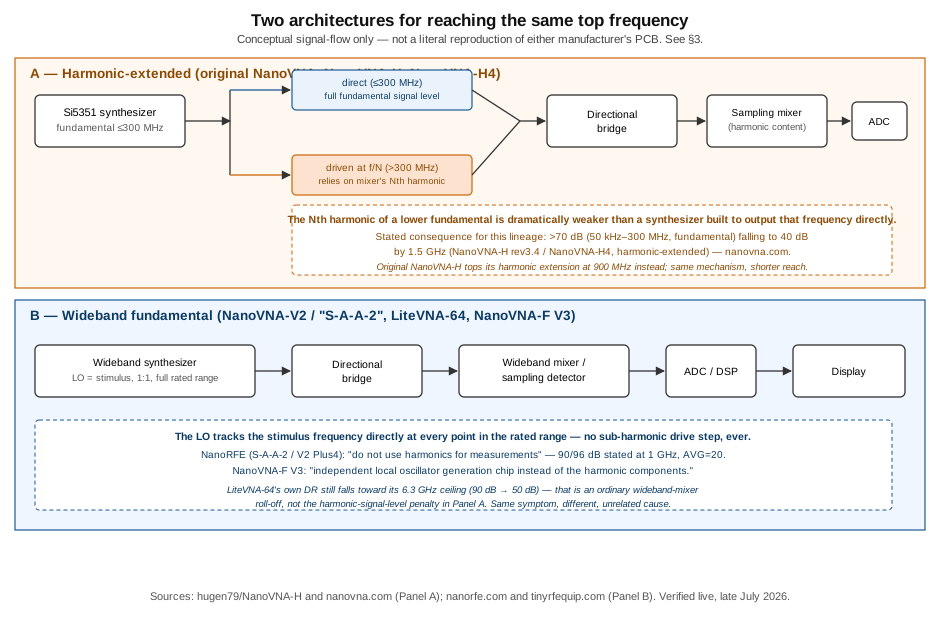
The original edy555 design and its direct Hugen-maintained descendants (NanoVNA-H, NanoVNA-H4) build their stimulus around a Silicon Labs Si5351 clock-generator chip. The Si5351 is a fine, cheap part, but it is not a general-purpose RF synthesizer — its own useful output range tops out in the low hundreds of megahertz, and the NanoVNA-H GitHub project page states the fundamental figure plainly: the Si5351 core delivers “50k-300MHz frequency range” with “better than 70dB dynamic” in that range. Everything above 300 MHz on this lineage is produced by a trick rather than a wider synthesizer: the same page describes an “improved frequency algorithm [that] can use the odd harmonic extension of si5351 to support the measurement frequency up to 900MHz,” with the most recent hardware revision “extended to above 1.5GHz.” Driving the Si5351 at, say, one-third of the target frequency and relying on the mixer’s own third-harmonic content to produce a usable signal at the target is a real and workable technique — it is also, unavoidably, a technique that throws away most of the fundamental tone’s power before the harmonic content ever reaches the DUT. The synthesizer’s fundamental output at 300 MHz is not weak; the third harmonic of a 100 MHz fundamental, which is what actually does the measuring work at 300 MHz in harmonic mode, is dramatically weaker than a synthesizer built to output 300 MHz directly. That signal-level penalty is exactly why nanovna.com’s own history page states that the harmonic-extended hardware “can achieve 40dB dynamic range up to 1.5GHz” — down from the 70+ dB the same hardware delivers in its native fundamental range. §8 returns to that specific pair of numbers and what they mean for a real measurement.
2.3.2 Fundamental (wideband-synthesizer) operation
A completely separate hardware lineage — designed from scratch by the ttrftech/OwOcomm team and currently maintained and sold through NanoRFE — takes the opposite approach: build a synthesizer and mixer chain wideband enough that the local oscillator always tracks the stimulus frequency 1:1, with no sub-harmonic driving and no reliance on harmonic content at the RF port. NanoRFE’s own product literature states this explicitly and contrasts it directly against the legacy design: describing the architecture as a “completely new, from-scratch architecture” and stating plainly that these boards “do not use harmonics for measurements.” Because the LO is always at the actual stimulus frequency rather than a fraction of it, the signal level presented to the mixer does not collapse as frequency rises the way a harmonic-extended design’s does — which is the entire reason this lineage’s dynamic-range figures (§8) hold up so much better toward the top of its range than the Si5351-harmonic lineage’s do. This is the architecture behind the products marketed as NanoVNA-V2, “S-A-A-2,” and the “Plus4” line (§5), and — through a related but separately engineered synthesizer chain — behind LiteVNA-64 (§6) and NanoVNA-F V3 (§7) as well. NanoVNA-F V3 in particular states its own version of the same idea in its own words: it uses “an independent local oscillator generation chip instead of the harmonic components” to reach its rated top frequency.
2.3.3 Why the fork matters more than the frequency number on the box
A specification sheet that says “50 kHz – 3 GHz” tells you the frequency a marker can be placed at; it tells you nothing about whether the signal at that marker is strong enough for the receiver to resolve a small reflection against its own noise floor. Two instruments can share an identical top-line frequency figure and differ by 30–50 dB in usable dynamic range at that top frequency, purely because one reaches it by tracking the LO 1:1 and the other reaches it by exploiting a harmonic of a much lower fundamental tone. This is the single fact the rest of this volume is organized around, and it is also the fact that a browsing buyer is least likely to see stated anywhere on a listing page — vendors quote the frequency ceiling prominently because it is an easy number to be proud of, and they are far less consistent about quoting the dynamic range at that ceiling, which is precisely why §8 insists on pairing every dynamic-range figure with the frequency (and averaging setting, where the manufacturer states one) it was measured at.
2.4 The original NanoVNA, V2 / V2.2, and the Hugen H / H4 lineage
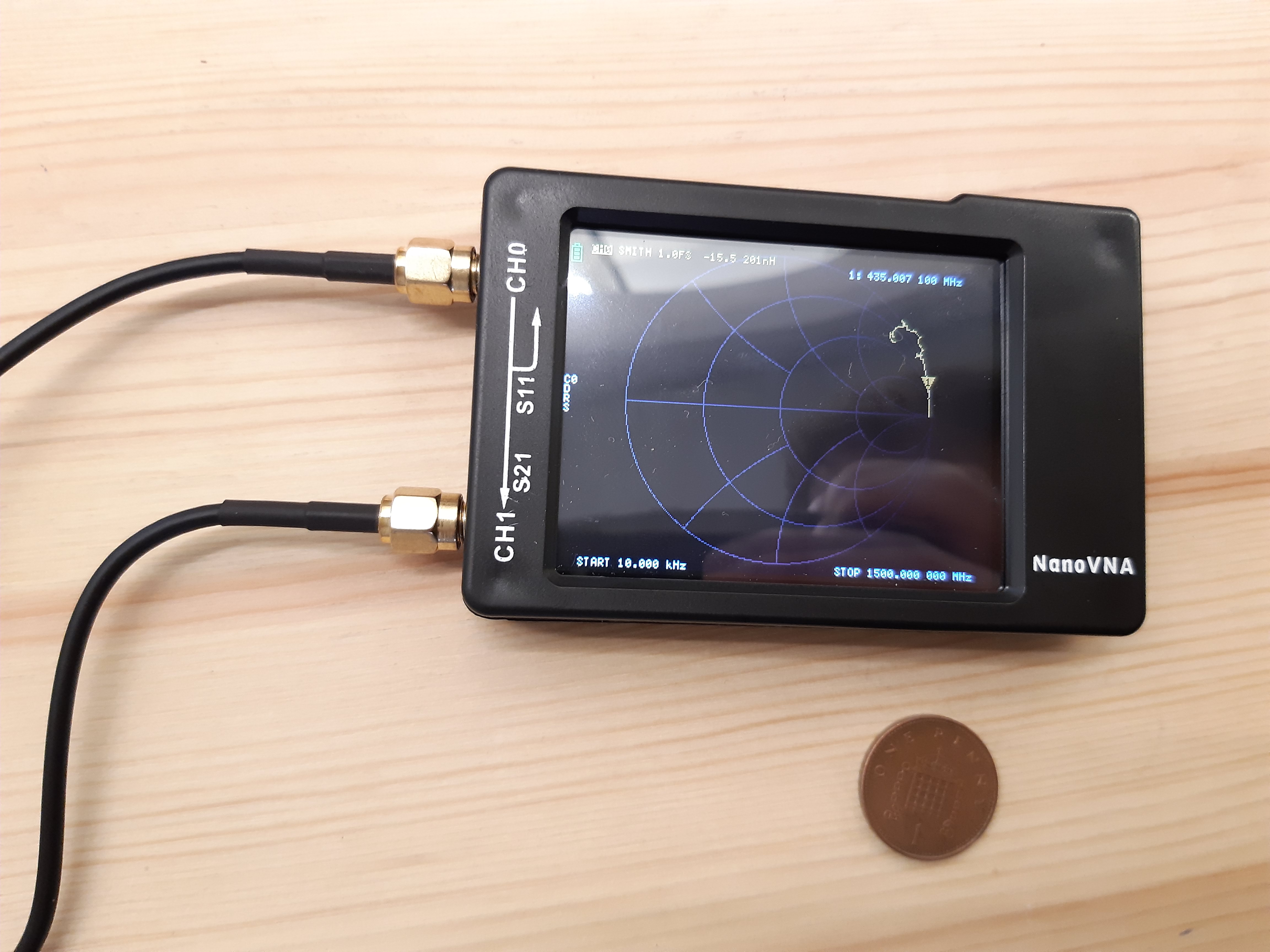
This is the Si5351-based, harmonic-extended family §3.1 described, and it is worth being precise about the naming inside it, because “V2” here means something entirely different from the “NanoVNA-V2” product covered in §5 — a collision this volume flags explicitly rather than letting a reader discover it the hard way on a shopping page. Within the original-architecture lineage, “V2,” “V2.2,” and similar version numbers refer to successive PCB hardware revisions of the same Si5351-based design — larger or smaller screens, added shielding, minor connector or battery-management changes — not a different RF architecture. A current representative of this baseline tier, sold today by Nooelec simply as “NanoVNA” ($99.95, verified live on Nooelec’s own product page), covers “50kHz-900MHz—and beyond with appropriate custom firmware” on a 2.8” TFT touchscreen, drawing from a 400 mAh battery through SMA test ports, with a stated frequency accuracy of 0.5 ppm and RF output around −13 dBm. That “900 MHz” ceiling is the harmonic-extended figure — the underlying Si5351 core is still the same 300 MHz-fundamental part §3.1 described, and Nooelec’s own page does not publish a dynamic-range figure for the extended region on this specific product, a gap this volume states rather than fills with a borrowed number from a different board.
NanoVNA-H4 is the larger-screen, longer-reach member of the same lineage, maintained under hugen79’s GitHub project and built around an upgraded STM32F303 microcontroller (versus the plain NanoVNA-H’s STM32F072) — the same repository states this processor split directly. Nooelec’s current NanoVNA-H4 listing (verified live, $124.95) quotes a “10kHz-1500MHz+” range on a 4” TFT touchscreen, a 1950 mAh battery, and SMA connectors, with the same 0.5 ppm accuracy and −13 dBm output figures as the smaller model; R&L Electronics carries the same product at $109.95 (also verified live this session), so a buyer should expect the street price to move within roughly that $110–$125 band across US resellers rather than treating either figure as fixed. Architecturally, the H4 is still the Si5351 core §3.1 described, still 50 kHz–300 MHz fundamental, still reaching its higher rated ceiling through odd-harmonic extension — and the dynamic-range consequence of that fact is exactly the pair of numbers nanovna.com’s own history page states for “NanoVNA-H rev3.4 and NanoVNA-H4”: better than 70 dB in the native 50 kHz–300 MHz range, falling to 40 dB by the time the sweep reaches 1.5 GHz.
None of the vendor pages checked this session publish a pixel-resolution figure for either screen in this lineage — the 2.8” and 4” figures above are diagonal screen sizes as actually stated by the seller, and this volume does not invent a resolution number to round the spec sheet out. What is worth carrying forward from this section is the shape of the tradeoff, not a memorized number: this is the cheapest, most widely resold tier of NanoVNA hardware, it is entirely adequate across its native HF/VHF/low-UHF fundamental range, and its upper-frequency numbers on the box are real in the sense that a marker will genuinely land there — but they arrive with a dynamic-range cost this section’s sources state explicitly, which is the entire reason §8 exists as its own section rather than being folded into a single bare “50–80 dB” range the way an earlier draft of this material did.
2.5 NanoVNA-V2 and the “S-A-A-2” fundamental architecture
The product line NanoRFE currently sells under the “S-A-A-2” architecture name is the from-scratch, fundamental-only design §3.2 introduced, and its own site organizes the lineup under exactly that header — “NanoVNA V2 Series (S-A-A-2 Architecture).” Two tiers currently ship: the base V2 and V2 Plus cover 50 kHz – 3 GHz, while V2 Plus4 and V2 Plus4 Pro extend that to 50 kHz – 4.4 GHz, all four using the same non-harmonic synthesizer approach — the manufacturer’s own words are that “V2 Plus4/Plus4 Pro do not use harmonics for measurements” — a statement scoped, in the source, to the Plus4 tier specifically. Extending it to the base V2 and V2 Plus is an inference from the shared S-A-A-2 architecture name rather than a direct quotation, and is flagged as such here. The Plus4 tier adds what NanoRFE calls “VNA-R architecture featuring temperature drift cancellation and reduced crosstalk,” and the two Plus4 dynamic-range figures actually carry the frequency and averaging condition this volume insists on: 90 dB for the Plus4, 96 dB for the Plus4 Pro, both stated specifically at “BW=1.6kHz, AVG=20, 1GHz” — the resolution-bandwidth term matters as much as the averaging one, so it is quoted here in full. Both Plus4 variants run from a standard 18650 cell — NanoRFE’s page specifies “flat-top unprotected 3.6V lithium-ion (3200mAh)” — with the Plus4 defaulting to a 0.25 s sweep and the Pro reaching 0.16 s at a 10 kHz IF bandwidth setting.
NanoRFE publishes more than a first pass at their site suggests, and it is worth setting out exactly what is and is not stated. The base V2/V2 Plus tier does have a published dynamic-range figure: NanoRFE’s own spec table gives 60 dB, “system dynamic range (calibrated)”, for the V2_2 and V2 Plus — but with no frequency or averaging condition attached, so it should be read the same guarded way as NanoVNA-F V3’s unqualified numbers in §7, not as a peer of the fully-conditioned Plus4 figures. Touch capability is stated for the whole Plus4 and VNA6000 range, via a comparison table with an explicit touchscreen row; what is genuinely absent is the screen size in inches and any explicit statement of connector type, and the SMA inference from every other family in §§4, 6 and 7 is flagged here as an inference rather than a source. Current retail prices are published on NanoRFE’s shop page: $299 for the V2 Plus4 and $399 for the Plus4 Pro, matching the figures Vol 5’s buy survey independently verified from the same vendor.
That brings the naming question this section exists partly to resolve: the model name “SAA-2N” appears in this hub’s migrated source material, and no manufacturer or current vendor page checked this session used that exact string. What every source did consistently use was “S-A-A-2” (hyphenated, as NanoRFE’s own architecture-name header renders it) for this entire fundamental-synthesizer product family. The most likely explanation is that “SAA-2N” is a reseller’s or an earlier draft’s mangled rendering of “S-A-A-2” — possibly conflated with the “N” that appears in unrelated NanoVNA-family names elsewhere — rather than a genuinely distinct fourth product. This volume treats the family under its confirmed name (S-A-A-2 / NanoVNA-V2, spanning the V2, V2 Plus, V2 Plus4, and V2 Plus4 Pro tiers just described) and flags “SAA-2N” explicitly as unconfirmed rather than quietly repeating it as if it were a separately verified model — which is exactly the discipline this whole section’s naming-collision discussion (§4, opening paragraph) is trying to model for the reader shopping against a listing page that may use either name loosely.
It is also worth noting, without expanding on it, that NanoRFE’s current site lists a newer, non-”NanoVNA”-branded successor line — “VNA6000,” covering 50 kHz – 6 GHz at a manufacturer-stated 95–110 dB — as its next-generation architecture beyond the S-A-A-2 family. That product sits outside this volume’s named scope and this dive’s “NanoVNA” framing, but a buyer researching the top of this market in 2026 should know the name exists.
2.6 LiteVNA-64 — extending the fundamental architecture to 6.3 GHz
LiteVNA-64 pushes the same non-harmonic design philosophy §5 described further up the spectrum, to a manufacturer-stated 50 kHz – 6.3 GHz, using what one vendor’s technical description calls a “single frequency mixer” arrangement with “multiple internal RF switches” handling the S11/S21 switching and IFFT-based TDR/DTF processing on top of that same front end. Current specifications verified live this session (from TinyRFEquip’s own product page) put the price at 899 RMB excluding tax — roughly $125–130 at exchange rates prevailing in mid-2026, though that conversion is this volume’s own approximation, not a vendor-quoted USD figure — on a 3.95” touchscreen, drawing from a 2000 mAh battery through SMA connectors, with USB-C connectivity and a microSD card slot for standalone data logging that neither of the two families in §§4–5 offer.
The dynamic-range story here is the cleanest illustration in this entire volume of why a bare number is close to meaningless without its frequency attached, and it is worth quoting the vendor’s own wording rather than compressing it into a single figure: “effective dynamics of better than 90dB” is stated specifically for the 1–3 GHz range with 20 averages, while the same source states plainly that the “effective dynamic reduction is reduced to 50dB at 6.3GHz.” That is a 40 dB collapse across the top half of the instrument’s own rated range — and it happens without any harmonic-extension mechanism at all. This is the fact this section exists to establish precisely: LiteVNA-64 belongs to the fundamental-architecture family (§3.2), not the harmonic-extended one (§3.1), so its degrading dynamic range toward 6.3 GHz is not the harmonic-signal-level penalty §4 quantified for the H4 — it is, on the best available reading, the ordinary and physically unavoidable falloff every wideband synthesizer-and-mixer chain experiences as it’s pushed toward the edge of its own design envelope, even when it never resorts to a harmonic trick to get there. That classification deserves an explicit flag rather than a confident assertion: TinyRFEquip’s own LiteVNA-64 page never uses the word “harmonic” at all. It describes a “single frequency mixer” with “multiple internal RF switches,” which is strongly suggestive of a fundamental-only wideband design and is the reading this volume adopts — but it is an inference from an architecture description, not a statement the manufacturer makes either way. Both mechanisms produce the same practical symptom — a noisier trace near the top of the sweep — but they are different mechanisms with different causes, and conflating “fundamental but degrading” with “harmonic-extended” is exactly the kind of architectural sloppiness this volume was written to correct.
No vendor page checked this session stated an explicit LCD pixel resolution or gave a separate dynamic-range figure for the intermediate 3–6.3 GHz band — the two anchor points (90 dB at 1–3 GHz/20AVG, 50 dB at 6.3 GHz) are the only two figures actually published, and this volume presents them as exactly that: two stated endpoints, not a curve interpolated between them. A buyer whose real interest is the amateur HF/VHF/UHF bands, plus perhaps the 1.3 GHz and 2.4/5.8 GHz amateur allocations, is operating almost entirely inside the well-characterized 1–3 GHz-class region this instrument’s own spec sheet is proudest of; a buyer chasing full-range Wi-Fi-6E or 6 GHz-adjacent characterization should read the 50 dB figure at face value and plan the measurement around it rather than assuming the box’s headline number describes the whole sweep uniformly.
2.7 NanoVNA-F V3 — an independent-LO tabletop design
NanoVNA-F V3 is architecturally closer to the fundamental family of §§3.2, 5, and 6 than to the Si5351-harmonic lineage of §4, and its own product description states the mechanism in almost identical language to NanoRFE’s: it uses “an independent local oscillator generation chip instead of the harmonic components,” reaching a manufacturer-stated 1 MHz – 6 GHz range without a sub-harmonic drive trick. Current specifications verified live this session (again via TinyRFEquip’s product page) list a 4.3” “high-brightness IPS display with resistive touch panel” — worth flagging against this hub’s own earlier migrated draft, which described this model as a 5” non-touch, button/encoder-driven tabletop unit; the current V3 revision checked this session is touch-capable at 4.3”, a genuine correction to that earlier characterization rather than a minor rounding difference. The unit draws from a comparatively large “4500mAh” battery rated for “endurance time up to 5 hours,” charges over USB-C in roughly three hours by the same source, uses SMA connectors, scans at up to 200 points per second with a maximum 801-point sweep, and ships in a metal enclosure with an SMA calibration kit and two RG405 semi-rigid cables included. Price verified live this session is 1300 RMB excluding tax — on the order of $180–190 at mid-2026 exchange rates, again this volume’s own approximation rather than a vendor-quoted USD figure.
The dynamic-range figures published for this model are the volume’s clearest example of the opposite failure mode from LiteVNA-64’s clean two-point disclosure: the same vendor page states “S21: 65 dB” and “S11: 50 dB” as flat figures, with no frequency or averaging condition attached to either number anywhere in the specification. That omission is stated here explicitly rather than resolved by assumption — this volume does not know, and could not confirm this session, whether those two numbers describe performance at the low end of the 1 MHz – 6 GHz range, some mid-band reference point, or a worst-case figure across the whole span, and a buyer comparing this instrument against LiteVNA-64’s explicitly frequency-tagged 90 dB/50 dB pair should weigh the F V3’s numbers with that missing context in mind rather than reading them as directly comparable.
Where NanoVNA-F V3 earns its “tabletop” reputation in this hub’s earlier framing is real even after the touch-versus-button correction above: a 4.3” display, a metal chassis, and a battery rated for a five-hour session are a meaningfully different physical object from a 2.8”–4” handheld, and the larger display genuinely helps reading a dense Smith-chart trace at a bench rather than in the field. What has changed since this hub’s migrated draft is the control surface — this is a touchscreen instrument in its current V3 revision, not the button-and-encoder unit an earlier pass described, and a buyer choosing between this and LiteVNA-64 on “touch versus tabletop” grounds should know that distinction has narrowed considerably.
2.8 Dynamic range done honestly
The migrated seed material this volume replaces quoted three flat bands — “50–60, 60–70, 70–80 dB” — with no frequency attached to any of them, and §§3–7 above should make clear why that framing is close to meaningless for this instrument family specifically. Dynamic range on a NanoVNA is not a fixed property of the box the way, say, its connector type is; it is a number that depends on where in the swept range you’re asking the question, whether you’re in fundamental or harmonic-extended operation at that point, and — for every model in this section — how many sweeps the firmware is averaging together (more averaging trades sweep time for a lower effective noise floor, which is precisely why NanoRFE’s own Plus4 figure is stated as “90dB” specifically “at AVG=20”).
Collecting the actual sourced figures from §§4–7 in one place: the Si5351-core lineage runs “better than 70dB” in its native 50 kHz–300 MHz fundamental range, falling to a stated 40 dB by the time NanoVNA-H4’s harmonic extension reaches 1.5 GHz — a 30 dB collapse directly attributable to the harmonic-extension mechanism §3.1 described. The S-A-A-2/NanoVNA-V2 Plus4 line holds 90 dB (96 dB for the Pro variant) at 1 GHz with 20 averages, a figure that does not carry a stated value at its own 4.4 GHz ceiling in anything checked this session — a gap this volume states rather than fills. LiteVNA-64 discloses both ends of its own curve explicitly: better than 90 dB across 1–3 GHz at 20 averages, falling to 50 dB by 6.3 GHz — a 40 dB fall that happens entirely within fundamental operation, with no harmonic mechanism involved. NanoVNA-F V3 states 65 dB (S21) and 50 dB (S11) with no frequency or averaging condition attached at all, the one figure in this section this volume genuinely cannot pin to a specific point in the sweep.
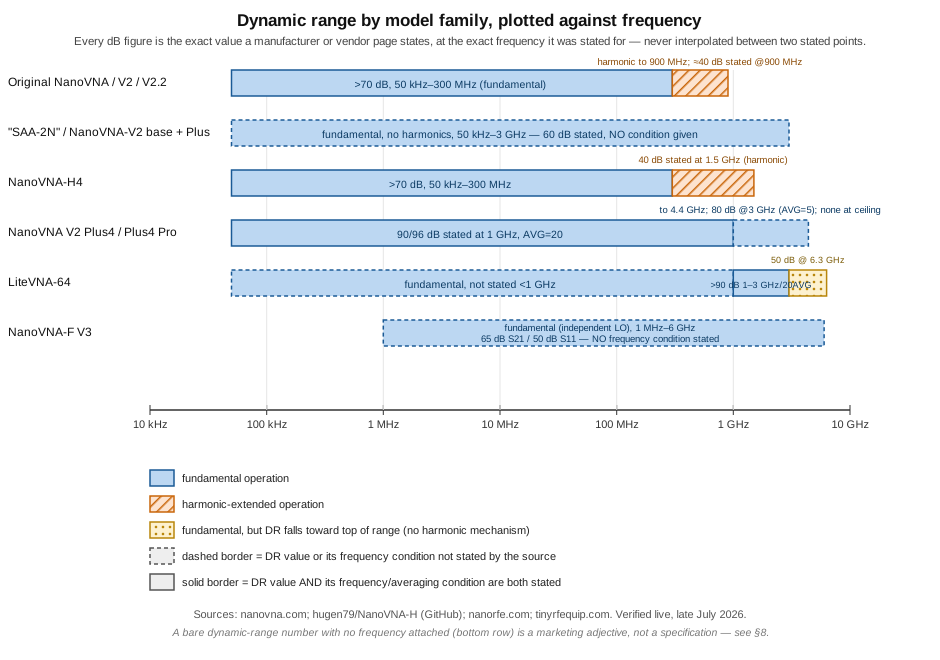
The practical reading of that figure, and of this whole section, is simple to state and easy to forget in the moment you’re comparing two listing pages: a dynamic-range number without a frequency is not a specification, it is a marketing adjective. Every dB figure this volume quotes above is quoted with whatever condition its source actually attached to it, and every place a source attached no condition at all, that absence is stated as its own finding rather than smoothed over. When you are deciding whether a given model’s dynamic range is adequate for a specific measurement — a coupler’s isolation, a filter’s stopband, a BALUN’s common-mode rejection — the number that matters is the one at your frequency of interest, not the best number anywhere on the box, and Vol 4 develops what that adequacy question looks like in the context of an actual S21 measurement rather than a spec sheet.
2.9 Comparison table and selection guide
2.9.1 Comparison table
Two of the specification categories this volume was asked to cover — screen and battery — turn out to have their own honesty problem, smaller in scale than §8’s dynamic-range discussion but the same in kind: not every vendor page publishes every figure, and a comparison table that quietly reuses a number from a different tier’s product page to fill a gap is committing the same error §8 spent a whole section correcting. The chart below plots exactly the battery-capacity and screen-size figures §§4–7 actually sourced, with the two cells this session’s research could not confirm — the base S-A-A-2/“SAA-2N” tier’s battery and screen, and the V2 Plus4 line’s screen — shown as hatched placeholders rather than silently omitted or filled in with a Plus4/Pro number that describes a different SKU.
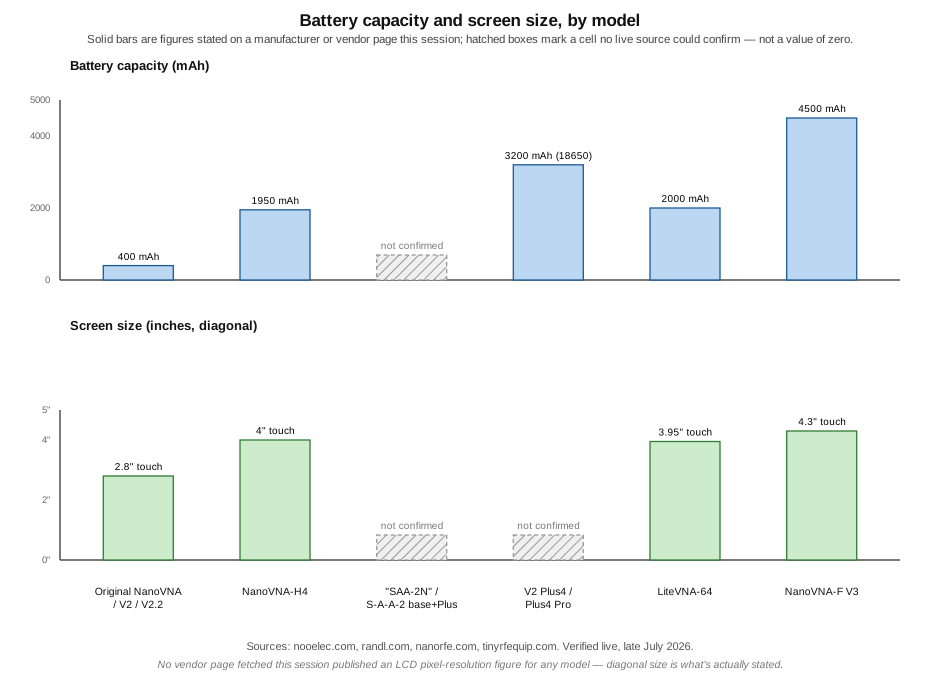
The pattern in that chart is worth reading before the table below, because it previews the same lesson §9.2 draws from the architecture: every model in this section’s price range uses SMA test ports — none of the six is built around the bulkier, more expensive N connector that shows up once you’re shopping in the traceable-cal-kit price range Vol 3 §7 described — and SMA’s own frequency ceiling (typically specified to 18–26 GHz by connector manufacturers) is nowhere close to being the limiting factor for any instrument in this volume’s comparison table; the limiting factor is always the synthesizer/mixer architecture §3 described, never the connector. Battery capacity, by contrast, tracks screen size and sweep speed fairly closely across the family — the smallest-screen, cheapest instrument also carries the smallest battery, and the two largest-battery instruments (V2 Plus4’s 18650 cell and NanoVNA-F V3’s built-in 4500 mAh pack) are also the two with either the fastest sweep engine or the largest display drawing current, which is an unsurprising engineering tradeoff rather than a meaningful differentiator on its own.
Table 1 — 9.1 Comparison table
| Family | Top frequency | How the top is reached | Dynamic range (as stated, with condition) | Screen | Battery | Connector | Price (verified live, late Jul 2026) |
|---|---|---|---|---|---|---|---|
| Original NanoVNA / V2 / V2.2 (Nooelec “NanoVNA”) | 900 MHz | Si5351 fundamental to 300 MHz, odd-harmonic extension above | >70 dB (50 kHz–300 MHz, fundamental); ≈40 dB (stated at 900 MHz, harmonic-extended) | 2.8″ TFT touch | 400 mAh | SMA | $99.95 (Nooelec) |
| NanoVNA-H4 | 1.5 GHz+ | Same Si5351 core; harmonic extension carried further | >70 dB (50 kHz–300 MHz, fundamental); 40 dB (stated at 1.5 GHz, harmonic-extended) | 4″ TFT touch | 1950 mAh | SMA | $109.95–$124.95 (R&L / Nooelec) |
| “SAA-2N” / NanoVNA-V2 (S-A-A-2), base + Plus | 3 GHz | Wideband fundamental synthesizer, no harmonics (inferred for this tier — the manufacturer quote names Plus4/Plus4 Pro) | 60 dB, calibrated (NanoRFE — no frequency or averaging condition stated) | Not stated in inches | Not stated | SMA (inferred from family; not independently confirmed) | Not listed separately |
| NanoVNA V2 Plus4 / Plus4 Pro | 4.4 GHz | Wideband fundamental synthesizer (“VNA-R”), no harmonics | 90 dB Plus4 / 96 dB Pro (stated at BW=1.6kHz, AVG=20, 1 GHz); 80 dB Plus4 (AVG=5, 3 GHz) | Touch confirmed (NanoRFE comparison table); size in inches not stated | 3200 mAh (18650 cell) | SMA (inferred; not independently confirmed) | $299 / $399 (nanorfe.com/shop) |
| LiteVNA-64 | 6.3 GHz | Wideband fundamental, single-mixer, no harmonics | >90 dB (1–3 GHz, 20AVG); 50 dB (stated at 6.3 GHz) | 3.95″ touch | 2000 mAh | SMA | ≈899 RMB / ≈$125–130 (TinyRFEquip) |
| NanoVNA-F V3 | 6 GHz | Independent LO chip, no harmonics | 65 dB (S21) / 50 dB (S11), no frequency condition stated | 4.3″ IPS resistive touch | 4500 mAh | SMA | ≈1300 RMB / ≈$180–190 (TinyRFEquip) |
Every cell above traces to a specific quote in §§4–7; a blank filled with “not confirmed” is a deliberate statement that this volume’s research this session did not turn up a live source for that cell, not an oversight.
2.9.2 Selection guide
For the great majority of what this hub’s antenna volumes actually ask a NanoVNA to do — an S11 sweep across an HF or low-VHF band looking for a resonance dip and a usable SWR bandwidth, the kind of measurement Vol 4 and Vol 5 build their workflows around — the cheapest current model in this table is usually sufficient. The original-lineage instrument’s native 70+ dB dynamic range comfortably covers everything from 160 m through 6 m without ever entering its own harmonic-extended region, its SMA ports and touch UI are identical in kind to every pricier model’s, and the workflow Vol 3 and Vol 4 teach does not change one bit based on which board is running it. Stepping up costs real money for capability an HF/VHF antenna builder is not using.
The cases that actually justify paying more are specific, and each one maps directly to an architectural fact this volume established rather than to a vague “better is better” instinct. Work that lives above roughly 900 MHz — 23 cm, 70 cm harmonics, the 1.3 GHz and 2.4 GHz amateur allocations, Wi-Fi-adjacent characterization — is exactly the region where the harmonic-extended lineage’s dynamic range has already fallen to the 40 dB region §8 quoted, and a fundamental-architecture instrument (§§5–7) is the correct answer, not a nicer version of the same answer. Filter and BALUN stopband or common-mode-rejection work that needs to resolve better than about 60–70 dB below the passband — the kind of measurement Vol 4 develops in its own S21 section — is running up against the harmonic-lineage’s own ceiling even inside its fundamental range, and benefits from the S-A-A-2/Plus4 family’s stated 90–96 dB figures. A buyer whose interest genuinely extends past 3 GHz into 5–6 GHz territory needs LiteVNA-64 or NanoVNA-F V3 specifically, because neither the original lineage nor the base S-A-A-2/Plus4 tier reaches that range at all; between those two, LiteVNA-64’s explicitly frequency-tagged dynamic-range disclosure (§6) is the more honestly specified instrument of the pair, while NanoVNA-F V3’s larger display and substantially larger battery (§7) suit a bench-bound, longer-session use case better than a field one. None of this is a ranked buying recommendation with specific current-year picks — that ranking, and the used-market and what-to-avoid guidance that goes with it, is Vol 5’s job; this section’s job was to make sure the ranking, wherever you read it, rests on the right architectural reasoning rather than a bare frequency number on a box.
2.10 Where this volume hands off
This volume took the single fiction the rest of this dive runs on — “the NanoVNA” as one instrument — and replaced it with the actual shape of the hardware market: a Si5351-based, harmonic-extended lineage running from edy555’s 2019 original through Hugen’s NanoVNA-H and NanoVNA-H4, and a separately engineered, wideband-fundamental lineage running from NanoRFE’s S-A-A-2/NanoVNA-V2 family through LiteVNA-64 and (via its own independent-LO approach) NanoVNA-F V3. It established that “fundamental versus harmonic” is the one architectural fork that actually predicts a model’s dynamic-range behavior at the top of its range, corrected a “SAA-2N” name this hub’s earlier migrated material carried without a confirmed source, corrected an earlier touch-versus-button characterization of NanoVNA-F V3, and insisted throughout that a dynamic-range figure without a stated frequency is not a specification a buyer can act on.
Three volumes now build directly on the ground this one covered. Vol 1 owns the Γ/S-parameter theory and the conceptual front-end block diagram this volume’s architecture discussion assumed as background. Vol 3 owns the calibration discipline that makes any of this hardware’s raw readings trustworthy in the first place — its own cal-kit price ladder ($595–$2,305 for traceable metrology kits) is the calibration-side equivalent of this volume’s honesty about instrument dynamic range. Vol 4 owns the actual S11/S21 measurement technique, the Smith-chart workflow, and time-domain reflectometry — the place where a given model’s dynamic range and frequency ceiling stop being spec-sheet numbers and start being the difference between resolving a −60 dB filter stopband or not. Vol 5 closes the dive with the field workflow, the ranked current-model purchase recommendations this volume deliberately did not make, and the honest limits section covering what none of this hardware — regardless of architecture — is good at. Readers whose needs genuinely exceed everything in this volume’s comparison table belong in the companion Other Analyzers & VNAs dive, which picks up exactly where a fundamental-architecture NanoVNA’s own ceiling runs out.
2.11 Resources
- nanovna.com — the original project’s own history and hardware page; the primary source for the 2019 edy555 origin, hugen’s DC-DC and 900 MHz contribution, the Si5351 fundamental/harmonic dynamic-range figures for the H/H4 lineage, and the explicit warning against fake “2.7GHz” listings. Verified live, late July 2026.
- hugen79/NanoVNA-H (GitHub) — the NanoVNA-H/H4 hardware project page; source for the STM32F072/F303 processor split, the Si5351 fundamental range and dynamic range, and the odd-harmonic extension mechanism. Verified live, late July 2026.
- NanoRFE (nanorfe.com) — manufacturer site for the S-A-A-2/NanoVNA-V2 architecture; source for the V2/V2 Plus/V2 Plus4/Plus4 Pro frequency ranges, the explicit “do not use harmonics” statement, the 90/96 dB dynamic-range figures at their stated 1 GHz/AVG=20 condition, the 18650 battery spec, and the existence of the newer VNA6000 line. Verified live, late July 2026.
- Nooelec (nooelec.com) — US reseller; source for current live prices and specifications for the base NanoVNA ($99.95) and NanoVNA-H4 ($124.95). Verified live, late July 2026.
- R&L Electronics (randl.com) — US reseller; source for a second current live price point on NanoVNA-H4 ($109.95). Verified live, late July 2026.
- TinyRFEquip (tinyrfequip.com) — vendor; source for current live LiteVNA-64 and NanoVNA-F V3 specifications and RMB pricing, including the frequency-tagged LiteVNA-64 dynamic-range figures and the NanoVNA-F V3 independent-LO architecture statement. Verified live, late July 2026.
- HamGeek (hgeek.com) and Passion Radio (passion-radio.com) — secondary vendor listings corroborating the LiteVNA-64 90 dB/50 dB dynamic-range disclosure independently of TinyRFEquip’s own page.
- Vol 1 — the S-parameter and Γ-plane theory, and the conceptual front-end block diagram, this volume’s architecture discussion builds on.
- Vol 3 — the calibration discipline and cal-kit quality/price ladder that makes any model in this volume’s comparison table trustworthy in practice.
- Vol 4 and Vol 5 — measurement technique and field workflow/ranked buying guidance, respectively, both of which assume this volume’s hardware distinctions as background.
Comments (0)